I went to Fort Collins, Colorado on Sunday, June 8 with a friend, who was the driver. The High Park Fire, which is near Fort Collins was visible, even from the highway. The fire is much worse now and has made National news. It has already claimed one life, destroyed a lot of homes, and displaced a large number of people from their homes. If you want to see updates on Twitter search #Highparkfire www.twitter.com
Here are my photos from Sunday afternoon, as we were headed south from Cheyenne, WY on I-25 South toward Fort Collins, Colo. The setting sun photos were taken in the evening as we were headed back on 1-25 North toward Cheyenne, WY. We passed a lot of Northern Colorado towns on our way home, which is where the Budweiser plant and ranch photos were taken.
All photos are taken by Karen Cotton, copyrighted and are not to be reprinted without permission.
This slideshow requires JavaScript.
Here are links from the Denver Post, of Denver, Colo. which has the best coverage so far.
Free Timed Entry Reservations Required (June 1 – August 19) General Public – Exhibit is included in the price of admissionMembers – Access to the exhibit will be included in your yearly membership benefits.
Adults 12 – 64
$15
Ages 65+
$12
Ages 3 – 11
$10
2 and under
FREE
More information about where to buy tickets, times and location of the Denver Zoo in Denver, Colorado.
By Kimberli Pierantoni, assistant entertainment reporter & Karen Cotton, editor of Life is as Sweet as Cotton Candy
(Denver, Colo) May 26, 2012– Come and see what all of the buzz is about. The Denver Zoo’s Asian elephants have already been a crowd pleaser during the zoo’s sneak peek to its new Toyota Elephant Passage Exhibit. The exhibit opens to the public on Friday, June first.
Asian elephants are enormous animals. They are 18 to 21-feet-long. The male elephant weighs an average of 11,500-15,000 pounds and are 10.5 feet tall. The female elephants average 7,700 to 9,000 pounds and are eight and a half feet tall. Female Asian elephants don’t have tusks, but do have small tushes inside the mouth.
On blazing hot days an elephant’s floppy ears regulate their body temperature. The Denver Zoo’s new Toyota Elephant Passage Exhibit provides children the opportunity to learn and have fun. There are ample opportunities for kids to learn and have fun. For example, there’s the leopard log, which allows kids to imitate the Clouded leopard.
Dale Leeds, who is a manager and curator of the Toyota Elephant Passage exhibit said, “Elephants are certainly a big focus of the area, but, I think it’s important to get across to the people that it’s about Tropical Asia, so even though they’re a key feature to the exhibit, it’s equally important to bring the attention to all the tropical animals here; the Greater one-horned rhinos, the large and island flying fox, the blood python, and not just the elephants.”
The Toyota Elephant Passage exhibit cost more than 50 million dollars in construction. “Toyota is the single biggest contributor to the exhibit,” Leeds said. “They contributed 5.2 million dollars, they’re contribution is amazing and is very much appreciated.”
The exhibit covers 10 acres and it has six large animal habitats. There are more than 130 gates throughout the exhibit to teach the animal’s operant conditioning. Those gates are operated at a central control center. The gates connect two miles of trails for the animals to explore. They also give visitors a unique up close experience with the animals.
Leeds said the Denver Zoo started planning the Toyota Elephant Passage exhibit back in 2003.
“We began building from there until we got to the point where we knew what we wanted to do. We had to do fundraisers to raise enough money and we needed to provide tools to make it happen. We broke ground on December 2009 and the real work began in 2010.”
Leeds came to the Denver Zoo in 1989. Leeds is a member of the Association of Zoos and Aquariums, Elephant Managers Association and helps out with the Steering Committee for the Elephant Species Survival Plan and Taxon Advisory Group. Leeds has worked with conservation projects to support elephants in Sri Lanka, Vietnam and Namibia.
Leeds’ job responsibilities are extensive. He started out as a zoo keeper and handler where he worked with elephants in 1989. Over time Leeds moved into a more managerial position, “I would say I made a significant contribution to the exhibit. I’m the champion provider of tools. I make sure the planning department knows what it takes for the zoo keeper to have what they need to take exceptional care of the collection. I make sure we have the right supplies and right staff members and assist with their training. I have an assistant curator and sixteen keepers. Now I’m in a supervisor role. First and foremost I work with the animals, then people rely on me to help assist them on animal care on a day-to-day basis,” said Leeds.
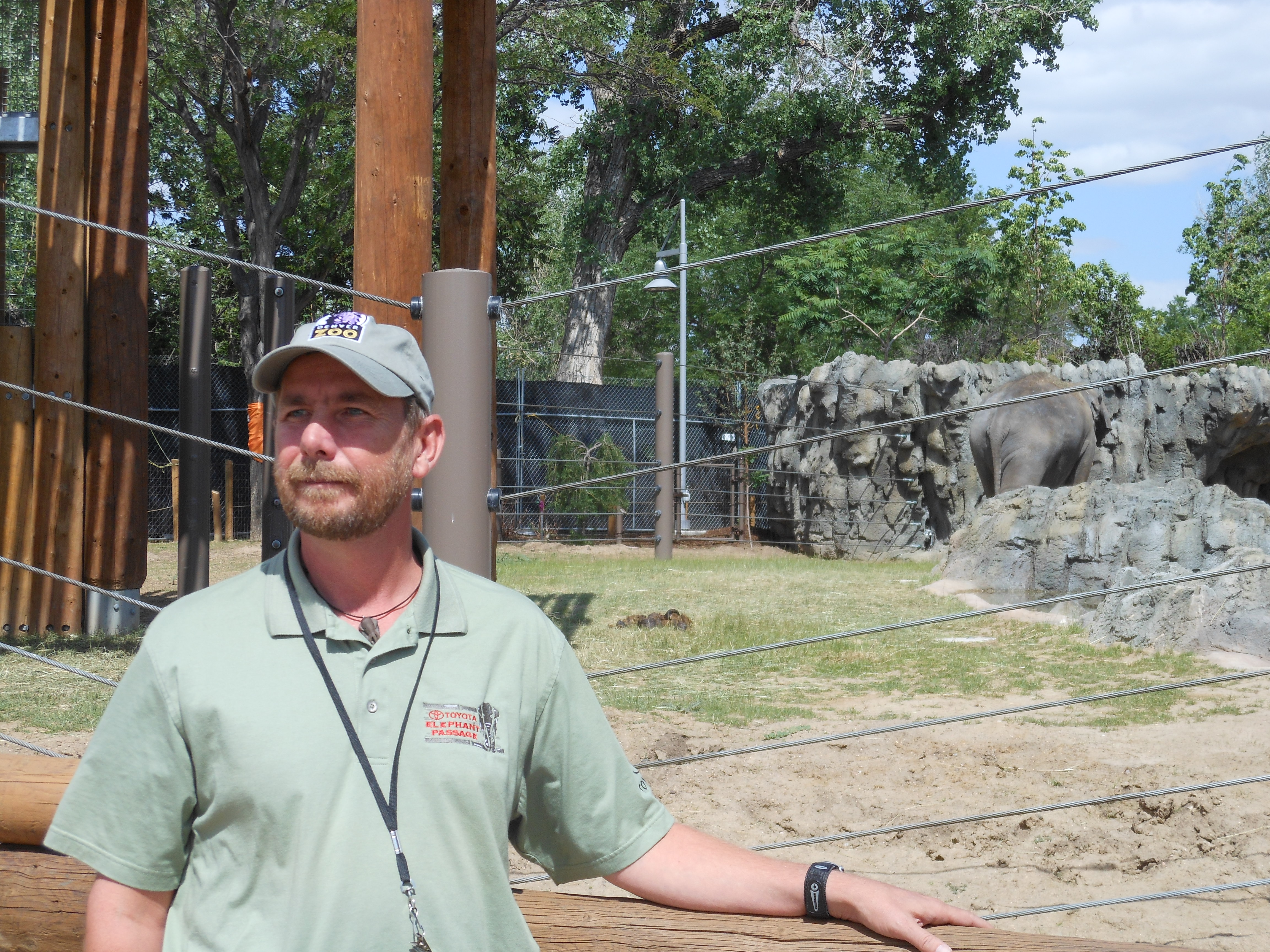
Dale Leeds, a manager and curator of the Toyota Elephant Passage exhibit, which opens to the public on Friday, June 1, 2012
Q and A with Dale Leeds
Kimba: Why did the zoo decide to put up this exhibit?
Leeds: “A little bit of a smart alec way to say this that is elephants in particular, and giant exhibits of this scale, can be farther out of reach for smaller institutions. Smaller institutions are equal contributors to conservation, so I’m not saying anything negative about anyone else, but an exhibit that can cost 50 million dollars. We have the ability to do it and the desire to do it so we should do it. Building an exhibit like this is easier for a big zoo to do. We have the resources from personnel, to expertise and financial aid to do it.”
Kimba: What is the main goal of the elephant exhibit?
Leeds: Our main goal is to improve our opportunities to participate in conservation. Due to our mission and core values we practically live it. Our driving force is conservation and we also participate extensively in education. This exhibit is meant to be a safe, educational environment for families to have fun. This gives our guest the opportunity to help the zoo out with our conservation projects.
Karen: What are the elephant’s names and did the zoo come up with them through a contest?
Leeds: No, typically we do not do naming contest here and two of the elephants came from other zoos. They already had names. Mimi is here and has been here for a good many of years. Dolly is here and has been here for a good number of years as well. Groucho the older male and Bodhi the young male are new residents to Denver.
Kimba: What are the elephant’s personalities like?
Leeds: Every elephant that I have been around are very different from one another. They may have some similarities, but they are their own individual animal. Mimi is an animal that is easy to be around, but one of her odd personality traits is that she gets frightened about new things or things that you would think an elephant would not worry about like geese. Dolly tends to be a lot more confident. Groucho is an older guy, kind of settled in his ways. He’s very easy to get around unless he’s in musk. Bodhi being an eight year old is in the mischievous part of his life so he can be quite challenging and destructive.
Kimba: How long have they been with the zoo?
Leeds: Mimi and Dolly had been here for a long time. Mimi got here in the early 60s. For example our two newest residents are Bodhi and Groucho. Bodhi got here in November of 2011 and Groucho has been here since the end of the course of January.
Karen: What is the main goal of the Denver Zoo?
Leeds: Well the main goal of this exhibit is to improve our opportunities to participate on conservation. It is very nice to work in an organization that doesn’t have a mission that is put up on a wall to look at. We live our mission here. The driving force is conservation. We also, participate extensively in education and provide an exceptional visitors experience as well. We want this place to be fun to come to, a nice place to enjoy yourself, enjoy time with your family and a safe, educational environment. This gives us an opportunity to have you help us with our conservation.
Kimba: What are the elephant’s daily exercises?
Leeds: It’s difficult for us to personally help with the elephants exercises because we are restricting contact with the animals. The elephants get to walk the trails which are two miles throughout the exhibit. The biggest thing we do to contribute to the exercise program is to use all these five beautiful yards that we have. Within time the animals will move into 2-4 yards every day. It’s giving them good reason to want to move around and walk a lot. The trail gives Mimi, Dolly, Groucho and Bodhi room to move around. Bridge crossing is done by Bodhi and Dolly right now. Mimi is still intimidated by the bridge to cross over.
Kimba: What is the elephant’s diet?
Leeds: They predominantly eat grass hay. They also get a grain supplement and a lot of fruits and vegetables and mineral vitamin supplements. The vast majority of their diet is grass hay.
Karen: Why are Asian elephants endangered?
Leeds: Asian elephants are more critically endangered because of their higher level of human elephant conflicts. We decided to go with Asian elephants instead of African elephants because there is a much greater conservation need. The Asian elephant’s population is as low as 35,000 compared to over 600,000 African elephants.
Kimba: If so what is the elephant population like?
Leeds: There are approximately 7% of countries that have elephants across the world.
Kimba: What is the zoo doing to help out the endangered animals?
Leeds: The zoo’s driving force is conservation. We provide exceptional visitor place, education and fun. Everybody here has an opportunity to help out. One of our workers is working on a conservation project in South East Asia. Personally my heaviest involvement is working with desert elephants in Neiva when we were concentrating on some of our programs on African elephants. Recently my biggest project is working on fence construction in Sri Lanka. As of now I provide the material and the training to other zoo members.
Karen: What kind of conservation work have you done around the globe?
Leeds: It is important to understand that everyone has the opportunity to participate with conservation in some shape or form. It’s certainly not just me. We have people throughout the organization working on elephant conservation in South East Asian conservation. Amy for example is working on snub-nosed monkeys. There are other people that have and will continue to work on elephant projects. My heaviest involvement has been working with desert elephants in Namibia where concentrating some programs on African elephants and more recently my biggest project has been working on fence construction in Sri Lanka. There was a big move where they tried to fence in conservation areas which were not an effective method. So someone came up with the idea of fencing in villages. We took that idea and because of my background with fences and construction provided materials and training to build these fences. I have recently been to Vietnam and am going back to work on the Vietnamese project there.
Kimba: How much do your elephants weigh and what is the average weight for a healthy elephant?
Leeds: I cannot have the exact answer to your question. Females and males weigh differently from each other. Age also makes a difference; a newborn weighs about 250 pounds. A typical adult female or male elephant ranges from 7,000-11,000 pounds. For example Mimi is 10,000 pounds; below the average weight for her age.
Kimba: Are the elephants afraid of anything?
Leeds: Mimi gets goofy and is afraid of new things although interestingly enough she has benefitted from this facility. This facility has increased her self-confidence.
What about mice?
As for mice, no, that is a myth. Small objects are unnoticeable to the elephants because their eyes are on the side of their head. For a larger animal it gets more difficult to see a small animal approach the closer it gets. It’s uncomfortable to have something scurrying around underneath you that you cannot see. It’s more related to motion.
Kimba: How do you know when an elephant is trying to communication with you?
Leeds: Elephants are similar to people. If they see, hear and smell you then you’re communicating. It’s very similar to learning a new language and a new culture. It’s imperative to learn and understand an elephant’s language which is body language and understanding of their culture makes communication easier.
Kimba: What sounds do they make?
Leeds: They are intelligent enough to meet us part way. The elephants can respond to English verbal cues. They do have a wide range of vocalizations. A lot of them are infrasonic.
Kimba: Are there any signs/hints that can help someone understand the elephant’s mood?
Leeds: Unless you come to interview us for eight hours every day for about three years you won’t understand the elephant. You have to experience it and be open to it.
Kimba: How do you train your elephants?
Leeds: We use a tool called Operate conditioning and its positive reinforcement based and it can work on anything. One of our main tools in operate conditioning is called successive approximation. We have a whistle to use as a bridge. If we had a completely naïve elephant we would say come here & if the elephant made the slightest motion to come here we blow that whistle which is known as the bridge and give a positive reinforce immediately. First thing is getting them to know I hear that whistle I get a treat. The animal will quickly associate the whistle with the reward they are getting. They have to improve upon that.
Kimba: What do you train them to do?
Leeds: We can train the animals to let us draw blood, give vaccinations, get a scrub bath, lay down on their chest or side and get in a pool.
It’s all based on positive reinforcement training. Most of the training contributes to their health care. Tricks like lifting of the feet which provides exercises. Other tricks can help contribute to their health and bathing. The zoo can train an elephant to lay on its chest or side during vaccinations and when blood is drawn. With training it also helps to give an elephant a bath. The basics of the training are to help them help us take better care of them. It makes taking care of the elephants easier.
Kimba: Have the zoo had any elephant babies?
Leeds: Haven’t had a baby born here. Bodhi just moved out of being a baby. We are not looking at having any babies in the future. There is not enough room for them to grow into.
Kimba: How does the zoo make the exhibit kid friendly?
Leeds: Instead of having barriers made of concrete or wood we found it best to have glass barriers. We do have play stations like leopard blog. This game offers play opportunity to imitate natural animals.
Karen: Do you intervene with circus elephants?
Leeds: There are eighteen people that work in the Asian elephant section. There are probably eighteen opinions about circuses. My personal feelings are that if it was a wild elephant or Circus elephants or zoo elephant there are pros and cons with each one of those life styles. Circus elephants are on the road a lot. This leads to more exercise for a circus elephant then to a zoo elephant. There a whole bunch of different ways to do things well and people have a different approach to it. I’m paid predominantly to speak for the Denver zoo and not like my own personal agenda.
Karen: Are there any educational programs for kids?
Leeds: There is a whole insert to this that talks all about that. One of the great things about working at the Denver zoo is it’s critically important to have solid educational programs, but I trust enough in my co-workers to know that those are the guys who have expertise in that area. They are going to conduct that and I’m going to focus on my part of my job and we will all come together around the first of June. We can probably spend the entire time of me listing off zoo educations.
Karen: If kids are inspired to work with elephants what kind of training do they need?
Leeds: Stay in school, stay in school, stay in school. It is a challenge to find someone who excels at zoo keeping because a person that improves is a person that is interested and motivated to do physical work like carpentry and landscaping. One also has to be motivated to do science research and math. People are typically drawn to one or the other of those things. You would have to truly enjoy gardening and physics. Stay in school and get a four year degree in a science related field and consider volunteering in an animal care facility.


 Life is as Sweet as Cotton Candy